
Home → Blog → Restaurant Marketing → Restaurant Website vs Facebook & Instagram: What Does Your Restaurant Need?
Restaurant Website vs Facebook & Instagram: What Does Your Restaurant Need?
Facebook and Instagram are powerful restaurant marketing tools, but they shouldn't be your entire online presence. Learn why a restaurant website works differently from social media and how the two can work together.
Restaurant Website vs Facebook & Instagram: What Does Your Restaurant Need?
Your restaurant already has Instagram.
You probably have Facebook too.
You post pictures of your food. You announce promotions. You upload stories. Customers comment on your posts.
So here's a question many restaurant owners eventually ask:
"Why do I need a website?"
It's a fair question.
If customers can find your restaurant on Instagram, see your food, message you, and find your phone number, isn't that enough?
Not exactly.
Facebook and Instagram can be incredibly useful for restaurants.
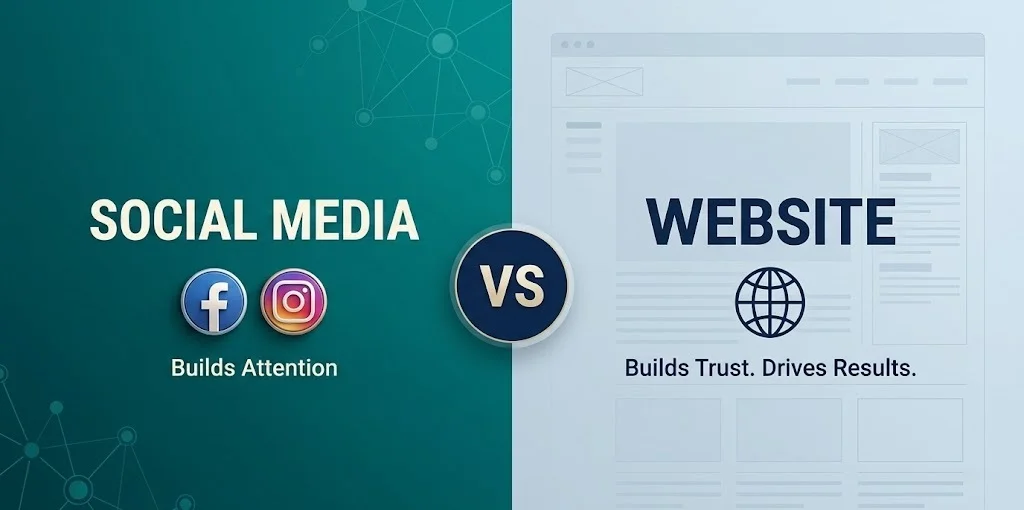
But social media and a restaurant website do completely different jobs.
One helps you build attention.
The other gives your restaurant an online home that you control.
And when you use them together, they become much more powerful.
The Simple Difference
Think of your restaurant like a physical business.
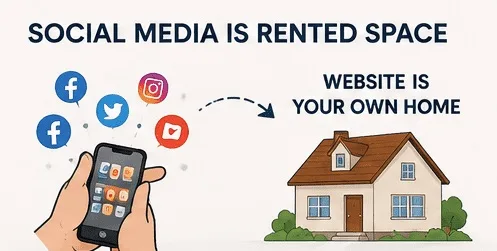
Instagram and Facebook are like busy streets where you put up signs and advertisements.
Your website is like owning the building.
You can attract people from the street, but once they enter your building, you control the experience.
That's the fundamental difference.
Social media platforms are excellent places to reach people.
Your website is a place where you can present your restaurant exactly the way you want.
Neither one completely replaces the other.
What Facebook and Instagram Are Good At
Let's give social media credit first.
Facebook and Instagram are extremely valuable for restaurants.
They're especially good for:
- Food photography
- Reels and videos
- Promotions
- Announcements
- Customer interaction
- Building a following
- Showing restaurant personality
- User-generated content
- Reaching existing customers
- Creating brand awareness
Imagine you've just introduced a new burger.
You can post a beautiful photograph on Instagram.
Someone sees it.
They share it with a friend.
Another person comments:
"Where is this?"
Someone else asks:
"How much?"
That's social media doing exactly what it's good at.
It's creating attention and conversation.
But eventually, customers usually need more information.
They want the menu.
They want the location.
They want the opening hours.
They want to know what else you serve.
And that's where your website becomes useful.
Your Instagram Profile Is Not Your Website
This distinction is important.
Your Instagram profile belongs to a platform.
Your restaurant website belongs to your restaurant.
If your Instagram profile is:
instagram.com/yourrestaurant
you're using Instagram's infrastructure, design, rules, algorithms, and features.
You don't control how Instagram changes its platform.
You don't control what features become available.
You don't control how your posts are distributed.
And you don't control whether a future algorithm change reduces your organic reach.
Your website is different.
You decide:
- What information appears
- How the menu is displayed
- How customers navigate
- What your restaurant looks like online
- Where your contact information appears
- Which pages exist
- What calls to action you use
That's why your website should be considered your owned online presence.
What Happens When Someone Searches Your Restaurant on Google?
Imagine a customer hears about your restaurant from a friend.
They search:
"Tony's Pizza."
Google shows your restaurant.
They see your Google Business Profile.
Then they see a website button.
What do you want that customer to find?
A properly structured restaurant website can give them:
Menu
About
Contact
Location
Restaurant information
Food photos
Clear next steps
Instead of making the customer search through dozens of Instagram posts to find yesterday's menu, you can give them a direct destination.
That's a much better customer experience.
Social Media Is a Feed. Your Website Is a Destination.
This is one of the easiest ways to understand the difference.
Instagram is designed around a feed.
Content constantly moves.
Today's post eventually gets buried under tomorrow's post.
Your website doesn't work that way.
Your menu can remain exactly where customers expect it to be.
Your Contact page stays accessible.
Your About page stays accessible.
Your restaurant information doesn't disappear because you posted something new.
Think about what happens when someone asks:
"What's your menu?"
On Instagram, you might say:
"Check our highlights."
Or:
"It's in the link in our bio."
That's already two extra steps.
With a restaurant website, you can simply say:
"Here's our menu."
And send them directly to it.
A Website Makes Your Menu Easier to Find
Your menu is one of the most important pieces of information your restaurant provides, so you should learn about the restaurant design and psychology behind how customers choose what to order.
But social media isn't necessarily designed to be a menu system.
You can upload menu photographs.
You can create a highlight.
You can make a menu post.
But as your menu grows, it can become difficult to navigate.
Imagine you have:
- 12 starters
- 15 main courses
- 8 burgers
- 10 pizzas
- 6 desserts
- 14 drinks
A customer doesn't want to scroll through 40 Instagram posts looking for the price of one dish.
A website can organize the information properly.
Starters
Chicken Wings Mozzarella Sticks Loaded Fries
Main Courses
Grilled Chicken Beef Steak Pasta Alfredo
Drinks
Soft Drinks Fresh Juices Milkshakes
That's a much more natural experience.
Your Website Can Be Your Digital Menu
For many small restaurants, the website doesn't need to be complicated.
It doesn't need:
- 20 pages
- A blog with 500 articles
- Complicated animations
- A huge development team
- Expensive custom software
A simple restaurant website can be incredibly effective.
For example, a small restaurant may only need:
Menu
About
Contact
That's enough to create a proper online home.
This is one of the ideas behind Menuberg.
A restaurant can create a full website without hiring a developer or maintaining a technical team.
A restaurant can even start with a dedicated Menuberg subdomain such as:
restaurant.menuberg.com
The restaurant owner manages the menu and website themselves. You Can Create Your Website Without Hiiring a Developer
Your Restaurant Website Can Work With Social Media
This isn't a competition.
You don't have to choose:
Website OR Instagram
You can use:
Website + Instagram + Facebook
And each can do what it does best.
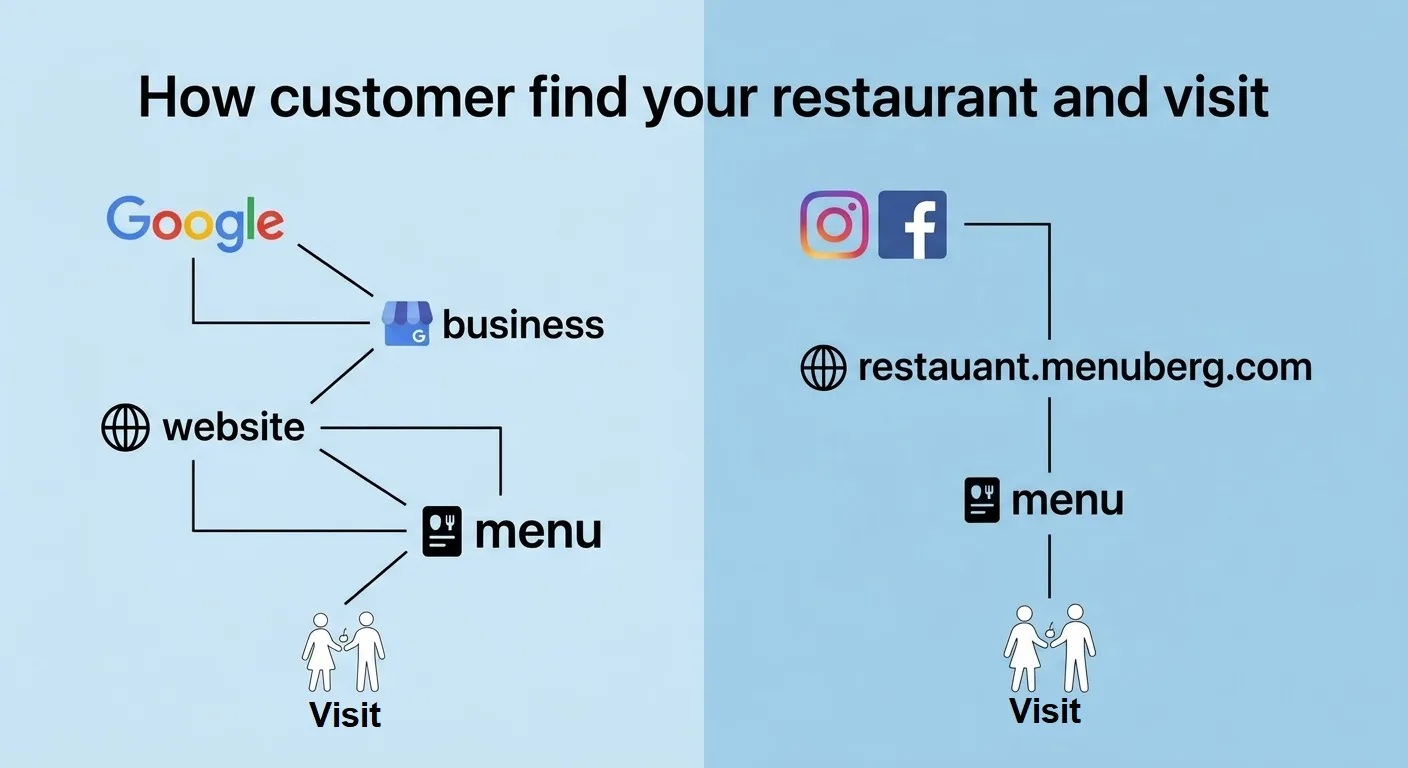
For example:
Show the new pizza.
↓
Customer
Clicks your bio link.
↓
Website
Sees the full menu.
↓
Customer
Checks location and opening hours.
↓
Customer
Visits the restaurant.
That's a complete customer journey.
Social media creates the interest.
Your website handles the information.
Your Website Gives You More Control
Social media platforms constantly change.
The design changes.
Algorithms change.
Features appear and disappear.
Organic reach changes.
Advertising policies change.
Account problems happen.
Sometimes an account can even become temporarily inaccessible.
Imagine your entire online presence depends on one social media account.
That's risky.
You don't necessarily need to abandon social media.
You simply shouldn't make it your only digital asset.
Your website gives you another foundation.
Social Media Followers Aren't the Same as Website Visitors
A restaurant might have:
10,000 Instagram followers
and still struggle to convert those followers into customers.
Why?
Because followers are not automatically customers.
Someone can follow you because they like your food photographs.
They might never visit.
Someone else might have only discovered your restaurant today and immediately become a customer.
That's why don't focus only on follower count.
Ask:
Can people easily find the information they need to visit my restaurant?
That's a much more useful question.
Your Website Can Help With Google Search
This is another major difference.
Social media can help people discover your restaurant.
But your own website can also become part of your search presence.
Think about searches such as:
"Italian restaurant in Brooklyn"
"best burger restaurant near me"
"vegan restaurant downtown"
"restaurant menu near me"
Your website gives search engines another source of information about your business.
Your pages can clearly describe:
- What you serve
- Where you're located
- Who you are
- What your menu contains
- How customers can contact you
And your website can be connected to your Google Business Profile.
This creates a stronger overall local presence.
If you're interested in this side of restaurant marketing, read our guide on How to Get Your Restaurant Found on Google.
Your Google Business Profile + Website + Social Media
Now we're getting somewhere.
Instead of thinking about these platforms separately, think about them as a system.
Google Business Profile
Helps people discover your restaurant through Google Search and Maps.
Website
Provides your restaurant's official online information.
Shows your food, atmosphere, personality, and daily content.
Helps you reach customers, share updates, and maintain another social presence.
Each channel supports the others.
A customer might discover you through Instagram.
Another might discover you through Google.
Someone else might find you through Facebook.
But they can all eventually reach the same destination:
Your restaurant website.
Your Website Doesn't Need to Be Expensive
This is where many small restaurant owners hesitate.
They hear "website" and immediately imagine:
"I need to hire a developer."
Then they imagine:
- Development costs
- Hosting
- Domain configuration
- Maintenance
- Updates
- Technical problems
- Security
- Designers
For a small restaurant, that's often unnecessary complexity.
Modern restaurant website builders can remove much of that technical work.
Menuberg, for example, is designed specifically for small restaurants, cafes, food trucks, and similar businesses that want a professional online presence without hiring a technical team.
A restaurant can create its website, manage menu items, switch unavailable items off with a click, choose from multiple themes and layouts, generate a QR menu, and monitor visitor activity from its dashboard.
And because the website can run on a restaurant-specific subdomain such as:
the restaurant can establish a dedicated web presence without having to understand web development.
Your Website Can Also Grow With Your Restaurant
Maybe you start with a simple website.
That's fine.
You don't need to build everything on day one.
You might begin with:
Menu
About
Contact
Then gradually improve it.
Add better photography.
Add more information.
Publish useful articles.
Create seasonal menus.
Improve your SEO.
Add more customer resources.
Your website can become more valuable as your restaurant grows.
That's very different from treating a social media profile as your entire online identity.
What About Customers Who Only Use Instagram?
Some customers will prefer Instagram.
That's fine.
Don't force them away from it.
Use Instagram to meet them where they already are.
But give them a clear path to more information.
For example:
Instagram bio → Website
Instagram post → Website
Instagram Story → Website
Facebook page → Website
Google Business Profile → Website
Your website becomes the central information hub.
What About QR Codes?
This is another place where your website can connect the physical and digital worlds.
Imagine a customer sitting at your restaurant.
They scan a QR code.
Instead of opening a huge PDF, they see a mobile-friendly restaurant website with the menu immediately available.
That's a much smoother experience.
A restaurant can also print QR codes for:
- Tables
- Counter
- Takeaway packaging
- Flyers
- Posters
- Business cards
Menuberg provides restaurants with QR menu functionality, allowing the digital menu to connect directly with the restaurant's website.
This creates a bridge between your physical restaurant and your digital presence.
The Real Question Isn't "Website or Social Media?"
It's:
"Where should my restaurant's online information live?"
Social media should be one of the places where you attract attention.
Your website should be one of the places where you provide information.
Google should help people discover you when they're searching.
Your reviews should help them trust you.
Your menu should help them decide.
And your restaurant should ultimately give them a reason to come back.
That's a much stronger strategy than trying to make one platform do everything.
Restaurant Website vs Facebook vs Instagram
Here's the simple comparison.
| Feature | Restaurant Website | ||
|---|---|---|---|
| Owned by your restaurant | Yes | No | No |
| Full menu | Excellent | Limited | Limited |
| Complete restaurant information | Excellent | Good | Limited |
| Google search potential | Yes | Some | Some |
| Food photography | Excellent | Good | Excellent |
| Short videos/Reels | Possible | Excellent | Excellent |
| Customer interaction | Good | Excellent | Excellent |
| Control over design | High | Low | Low |
| Permanent information | Excellent | Moderate | Low |
| Direct customer discovery | Through search | Through platform | Through platform |
| Restaurant branding | High | Moderate | High |
| QR menu destination | Excellent | Possible | Possible |
| Analytics/control | High | Platform-dependent | Platform-dependent |
The important takeaway isn't that websites are "better" than social media.
It's that they serve different purposes.
So, Does Every Restaurant Need a Website?
For most restaurants serious about building a long-term online presence, yes, having your own website is worthwhile.
But it doesn't have to be complicated.
You don't need a giant corporate website.
You need a useful one.
At minimum, make it easy for customers to answer:
What do you serve?
Where are you?
When are you open?
How can I contact you?
What does your food look like?
Where's the menu?
If your website answers those questions quickly, it's already doing an important job.
The Best Strategy: Don't Choose
If your restaurant has the resources to maintain only one thing today, start with the platform where your customers are already active.
But as your business grows, don't build your entire digital presence on rented land.
Build your own foundation.
Use Instagram to showcase the food.
Use Facebook to communicate with customers.
Use Google to help people discover you.
Use your website to give customers a reliable place to learn about your restaurant.
Use your online menu to help them decide.
And use your physical restaurant to deliver the experience that turns them into repeat customers.
That's the real digital strategy.
Social media gets attention.
Google helps people discover you.
Your website gives your restaurant a home.
And you don't have to choose between them.
Ready to build your restaurant's online presence?
Menuberg helps restaurants launch a professional website and QR digital menu in minutes — no coding required.
Create Your Restaurant WebsiteRelated Articles
Restaurant Marketing Checklist: What to Do Every Week and Every Month
A realistic, no-burnout routine for restaurant marketing — what's worth checking weekly, reviewing monthly, and revisiting every few months, without turning it into a second job.
11 Sept 2026 · 13 min read
New Restaurant Checklist: Getting Your Online Presence Right From Day One
A practical, ordered checklist for getting your restaurant's website, Google profile, menu, and social presence right before, during, and after opening week — not scrambled together at the last minute.
3 Sept 2026 · 12 min read
How to Handle Negative Restaurant Reviews: A Practical Dos and Don'ts Guide
A bad review doesn't have to hurt your restaurant's reputation — how you respond to it does more work than the review itself. Here's a clear, practical dos-and-don'ts approach.
6 Sept 2026 · 14 min read
About Menuberg
Menuberg helps restaurants create professional websites and digital storefronts without complicated setup. Learn more.