
Home → Blog → Restaurant Growth → How to Handle Negative Restaurant Reviews: A Practical Dos and Don'ts Guide
How to Handle Negative Restaurant Reviews: A Practical Dos and Don'ts Guide
A bad review doesn't have to hurt your restaurant's reputation — how you respond to it does more work than the review itself. Here's a clear, practical dos-and-don'ts approach.
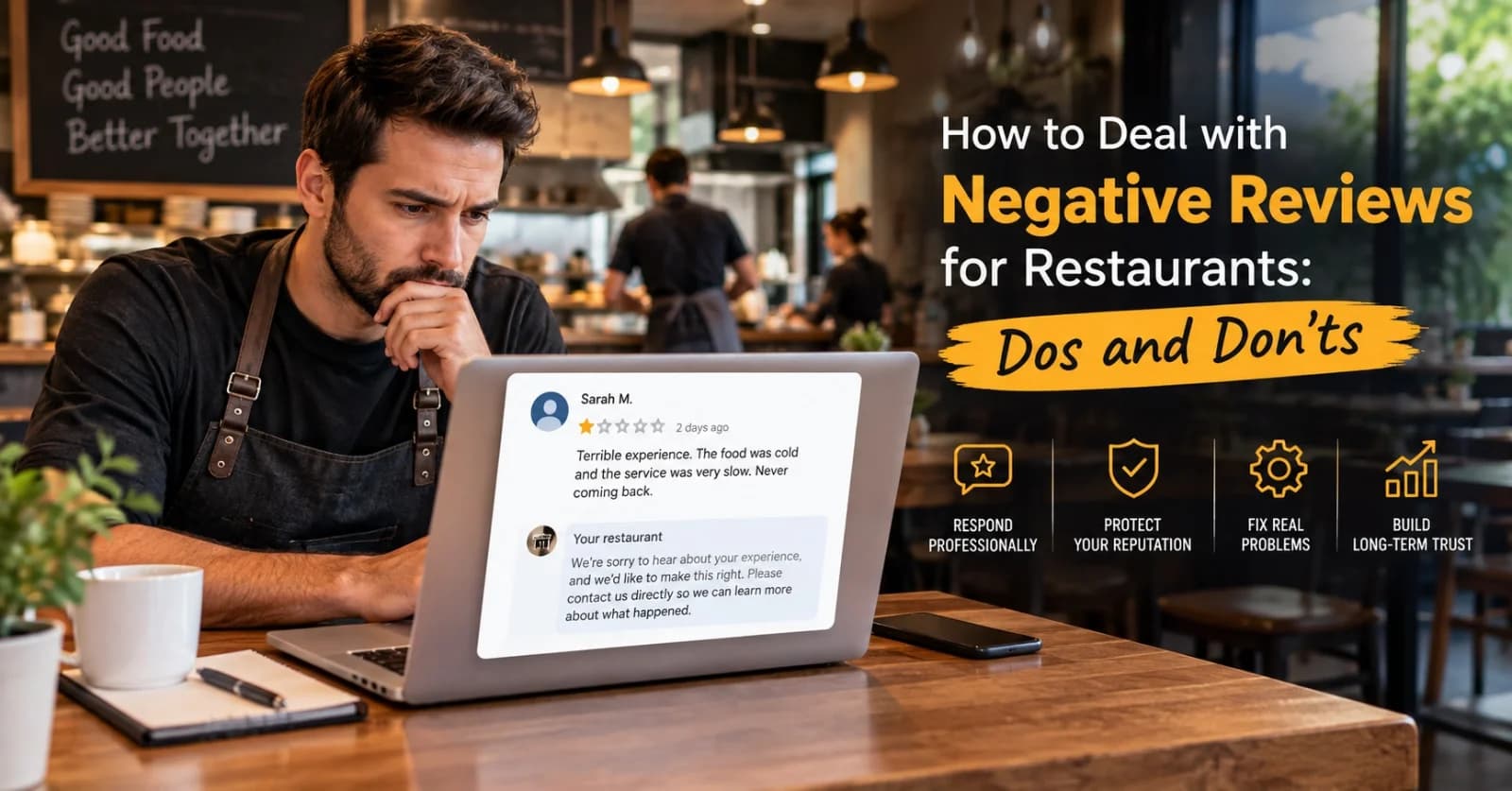
How to Handle Negative Restaurant Reviews: A Practical Dos and Don'ts Guide
You open your phone, check your restaurant's page, and there it is.
"Terrible experience. Never coming back."
Your stomach drops a little, even if you know exactly what happened that night. Maybe the customer has a point. Maybe they misunderstood the menu. Maybe the kitchen genuinely had a bad hour. Or maybe the review is simply unfair, and you're already composing a reply in your head that you'll regret sending.
Don't send that reply.
A bad review isn't just a message from one unhappy customer — it's something every future customer can read, alongside your response to it. And often, how you respond says more about your restaurant than the original complaint does.
Here's the reassuring part: you don't need a spotless five-star average to have a strong reputation. Every restaurant has an off night eventually — a delayed order, an inconsistent dish, a server having a rough shift. What separates restaurants people trust from ones they avoid isn't the absence of complaints. It's what happens after.
Don't Panic Over One Bad Review
A single one-star review usually feels much bigger to you than it does to anyone reading it. You know the whole story behind it — the busy Saturday, the short-staffed kitchen, the customer who arrived already annoyed about parking. A stranger scrolling through your reviews sees none of that context. They see a broader pattern: a wall of positive reviews, a handful of average ones, one or two rough ones, and — critically — how you responded to the rough ones.
The goal was never to have zero negative reviews. That's not realistic for any restaurant that's actually busy. The goal is a reputation solid enough that one bad night doesn't define it. Treat the occasional negative review as information about your operation, not as an emergency to extinguish.
Never Respond While You're Angry
This is where most restaurant owners get into trouble.
You remember exactly what happened. You know the customer left out half the story. So you start typing something like "you were already complaining before your food even arrived" or "we have thousands of happy customers, so you're clearly the problem." It feels satisfying for about thirty seconds — right up until you remember that response is sitting there permanently, for anyone considering a reservation to read.
If a review genuinely irritates you, step away from it. Talk to the staff who were working that night. Pull the order if you have records. Find out what actually happened. Then reply once you're thinking like an owner managing a reputation, not like someone defending their own night.
What to Do When You Get a Negative Review
Read the Whole Review, Not Just the Star Rating
A one-star review that says "food was awful" and one that says "I waited 45 minutes and nobody explained the delay" need completely different responses. The second one hands you something specific to work with — the first doesn't, and pushing back on vague complaints rarely goes well. Look for the actual complaint underneath the rating: was it the wait, the temperature of the food, an order mix-up, the price, the noise level, something about cleanliness? That detail decides everything about how you reply.
Investigate Before You Respond
Before you apologize or push back, find out what actually happened. Check the order against your records. Look at the time and date against your staffing that evening. If someone claims "they charged me $20 for a $12 burger," check your current menu before assuming either the customer or your POS system is wrong — maybe they ordered a combo, maybe your online menu is showing an outdated price, maybe there genuinely was a charging error. You can't write a credible response to a problem you haven't actually confirmed.
Acknowledge Without Agreeing to Everything
There's a real difference between "you're right, our restaurant was terrible" and "we're sorry your visit didn't go the way we'd want." The second one shows you understand the customer was unhappy without conceding every claim in the review as fact. It's usually the better opening line, especially when parts of the review feel exaggerated or one-sided.
Be Specific — Generic Replies Read as Fake
"We're sorry to hear about your experience, customer satisfaction is our top priority, please contact us" is the reply everyone recognizes instantly as copy-pasted, because it is. It signals nobody actually read the review. Compare that to something like: "We're sorry about the wait on Saturday night — we had an unexpected kitchen delay and should have communicated it better to the tables affected." That reads as a real person who looked into what happened, which is exactly the impression you want.
Move Complicated Conversations Offline
A public comment thread is the wrong place to work through a refund, a specific staff member's conduct, payment details, or anything involving a food-safety concern. In those cases, invite the customer to reach out directly: "We'd like to understand exactly what happened — please contact us with your visit details so we can look into it properly." This keeps sensitive details out of a public thread while still showing you're taking the complaint seriously.
Say Thanks When the Feedback Is Genuinely Useful
Not every negative review is an attack — some are just someone pointing out a real problem you hadn't noticed yet. If a review mentions the website menu showing a dish that wasn't actually available, and then two more reviews mention the exact same thing, that's not a coincidence to apologize your way past. That's a menu page that needs fixing. The most useful response to that kind of feedback often isn't a better sentence — it's a corrected listing.
Reply Even When You Can't Fully Fix It
Sometimes the complaint just comes down to taste — a dish that most people love didn't land for this one customer, or your restaurant simply doesn't offer something they expected. You can still respond respectfully: "We're sorry this dish wasn't to your taste — everyone's preferences differ, and we appreciate you giving us a try." Good reputation management isn't about agreeing with every reviewer. It's about disagreeing without being dismissive.
What to Avoid
Don't Argue in Public
Even when you're certain you're right, a visible back-and-forth rarely makes the restaurant look good. Picture a stranger reading "the staff were rude" followed by "you were rude first." Nobody wins that exchange — the reviewer gets attention, the restaurant looks defensive, and the person reading it quietly picks somewhere else to eat. Remember you're not really replying to the one reviewer. You're replying to everyone who reads it afterward.
Don't Attack the Reviewer Personally
Calling someone a liar, cheap, entitled, or a fake customer — even when you strongly suspect it — almost always backfires. Compare "you clearly don't understand how restaurants work" with "we couldn't locate an order matching these details, and we'd welcome the chance to look further if you share the date and order information." Same underlying skepticism, very different impression.
Don't Reveal Private Details
Never post a customer's phone number, order details, payment information, or anything about their personal circumstances, no matter how tempting it is to "set the record straight" with information they didn't mention publicly. Keep the reply focused on the restaurant's side of things and move anything sensitive to a private message.
Know the Difference Between an Explanation and an Excuse
"We're always busy, you should expect to wait" is an excuse. "We had an unusually long kitchen delay that evening and should have communicated it better" is an explanation. Customers rarely expect a flawless night every time — they expect ownership when something genuinely goes wrong.
Don't Turn Every Reply Into a Coupon
Offering "come back and we'll give you 50% off" under every public complaint has two problems: it makes your responses look like a promotion rather than a genuine reply, and it can quietly encourage people to complain publicly just to see if they get an offer. If compensation is appropriate, handle it privately — and remember that fixing the actual problem does more for your reputation than any discount code.
Don't Try to Erase Every Negative Review
If someone genuinely visited and had a rough experience, disliking what they wrote isn't grounds for trying to get it taken down. Most review platforms — Yelp, TripAdvisor, Facebook, and Google Maps alike — have policies against fake engagement, spam, and reviews unrelated to a real visit, and those are the situations worth reporting. "I don't like this review" and "this review breaks the platform's rules" are two very different things, and treating them as the same one is a fast way to look thin-skinned.
Spotting Fake or Suspicious Reviews
There's a real difference between a genuinely unhappy customer and someone who may never have set foot in your restaurant. One review you can't match to an order isn't automatically fake — plenty of real customers pay in cash, book under someone else's name, or just don't leave detailed enough information to trace.
What's worth investigating is a pattern: a sudden cluster of one-star reviews arriving within hours of each other, near-identical wording across several accounts, reviews that seem to describe a different business entirely, or a stranger contacting you offering to remove negative reviews for a fee. That kind of activity shows up across Yelp, TripAdvisor, and Facebook just as much as Google, and each of those platforms has a reporting process for it. Use it — but do the reporting through the platform, not through a public back-and-forth in the review section itself.
Never Fight Fake Reviews With Fake Reviews of Your Own
If you suspect someone's targeting you with fabricated negative reviews, the instinct to ask ten friends to post glowing five-star reviews in response is understandable — and it's a mistake. Buying reviews, creating fake accounts, or asking friends and family to pose as customers can create a far bigger problem than the one you started with, since most platforms actively look for exactly this kind of coordinated activity, and getting caught tends to do more damage than the original fake reviews ever would have. In the US, the FTC's rules on consumer reviews also specifically cover buying, selling, or incentivizing fake reviews.
The more durable fix is slower but far more reliable: keep earning genuine reviews from real customers, and don't only ask the ones you're confident will leave five stars. A review profile built entirely on hand-picked happy customers tends to look — and eventually be revealed as — exactly that.
Sample Responses for Common Complaints
When the food itself was the problem: "We're sorry the meal didn't meet your expectations — that's not the experience we want for anyone who visits. We'd like to understand what went wrong, so please reach out with the details of your visit."
When service was too slow: "We're sorry about the long wait — that's frustrating, especially when you're hungry. We should have communicated the delay better, and we're addressing it with the team."
When the complaint is about price: Resist the urge to defend your pricing outright. Try: "We understand value matters, and we're sorry the visit didn't feel worth it to you. We appreciate the feedback and will keep it in mind as we review our menu."
When the review is based on a misunderstanding: Don't embarrass the customer publicly. Try: "We're sorry for the confusion — that dish is actually served [brief clarification]. We can see how the menu description didn't make that clear, and we'll update the wording."
A Simple Five-Part Formula for Any Response
When you're not sure what to write, this structure covers almost every situation:
- Acknowledge the customer's experience
- Apologize where it's warranted, without agreeing to everything
- Address what happened, briefly
- Invite them to continue the conversation privately if needed
- Improve — use the complaint internally so it doesn't repeat
Put together: "We're sorry your visit didn't meet expectations. We understand your frustration with the wait, and we should have communicated the delay better — we're reviewing this with the team. If you're willing, please contact us with your visit details so we can look into it further."
Short. Calm. Specific. No argument.
Should You Respond to Every Negative Review?
In most cases, yes — but a response doesn't need to be an essay. Three honest sentences usually beat five polished paragraphs. What you're really communicating is: we saw this, we're taking it seriously, and here's what we're doing about it.
If you're handling enough reviews that your team needs a starting framework, build one — but keep it a starting point, not a script. A reply that reads like it came from a template every time is only marginally better than no reply at all.
Turn Repeated Complaints Into Real Fixes
This is where negative reviews earn their keep. Say your last thirty negative reviews break down like this: six mention slow service, five mention confusing menu descriptions, four mention parking, three mention portion size, two mention wrong opening hours. That's not five unrelated problems — it's likely one or two operational issues showing up in different disguises. Slow service, for instance, might actually trace back to an overcomplicated menu, understaffing during peak hours, or poor handoffs between kitchen and floor.
Reviews will tell you what customers experienced. They won't always tell you the root cause — that part is on you to dig into.
Keep Your Website Consistent With What Reviewers See
Your review strategy doesn't exist in isolation from the rest of your online presence. If someone reads a complaint that your restaurant was closed when Google said it was open, then checks your website and finds the same outdated hours, you've just handed them the same disappointment twice. Fixing the Google listing without fixing the website means the exact same complaint can resurface next week from someone else.
This is one of the more overlooked reasons to keep a real, current website in the first place — see New Restaurant Checklist: Getting Your Online Presence Right From Day One for the broader setup, and How to Create a Restaurant Website Without Hiring a Developer if you don't have one yet. If menu confusion keeps showing up in reviews specifically, it's usually worth a look at Restaurant Menu Design & Psychology too — sometimes the fix isn't the food, it's how the menu describes it.
Build a Reputation That Doesn't Depend on Five Stars
The real fix for negative reviews was never a better comeback line. It's consistent food, a menu that matches what's actually being served, clean surroundings, clear communication, and accurate hours — the kind of groundwork covered in our guide to Google Business Profile for Restaurants — plus a habit of actually fixing what reviews reveal instead of just replying to them.
The Negative Review Dos and Don'ts Checklist
Do
- Read the full review before reacting to the rating
- Investigate what actually happened
- Respond once you're calm, not right away
- Acknowledge the experience without conceding every claim
- Address the specific complaint, not a generic version of it
- Move complicated issues to a private conversation
- Protect customer privacy in every public reply
- Report reviews that genuinely violate a platform's policies
- Watch for the same complaint appearing repeatedly
- Fix the operational issue a review reveals, not just the wording
Don't
- Reply while you're still angry
- Insult or accuse the reviewer publicly
- Argue back and forth in the comments
- Post any private customer details
- Turn every apology into a coupon offer
- Try to delete reviews simply because you dislike them
- Buy reviews or ask friends to pose as customers
- Only ask your happiest customers for feedback
Your Response Is Part of Your Reputation
A negative review is written by one person. Your response is read by everyone who comes after them.
The goal was never to win the argument in the comments. It's to leave a future customer thinking: even when something went wrong here, they handled it like professionals. A restaurant with a handful of imperfect reviews and thoughtful, honest responses often comes across as more trustworthy than one with a suspiciously flawless five-star page — because everyone reading reviews already knows perfect doesn't really exist.
Ready to build your restaurant's online presence?
Menuberg helps restaurants launch a professional website and QR digital menu in minutes — no coding required.
Create Your Restaurant WebsiteRelated Articles

How to Get Repeat Customers Without a Loyalty App
Loyalty apps aren't what actually brings restaurant customers back. Here's what does — and how small, independent restaurants can build real repeat business without an app or a points system.
31 Aug 2026 · 9 min read

Restaurant Marketing Checklist: What to Do Every Week and Every Month
A realistic, no-burnout routine for restaurant marketing — what's worth checking weekly, reviewing monthly, and revisiting every few months, without turning it into a second job.
11 Sept 2026 · 13 min read

New Restaurant Checklist: Getting Your Online Presence Right From Day One
A practical, ordered checklist for getting your restaurant's website, Google profile, menu, and social presence right before, during, and after opening week — not scrambled together at the last minute.
3 Sept 2026 · 12 min read
About Menuberg
Menuberg helps restaurants create professional websites and digital storefronts without complicated setup. Learn more.