
Home → Blog → Restaurant Marketing → Restaurant Marketing Checklist: What to Do Every Week and Every Month
Restaurant Marketing Checklist: What to Do Every Week and Every Month
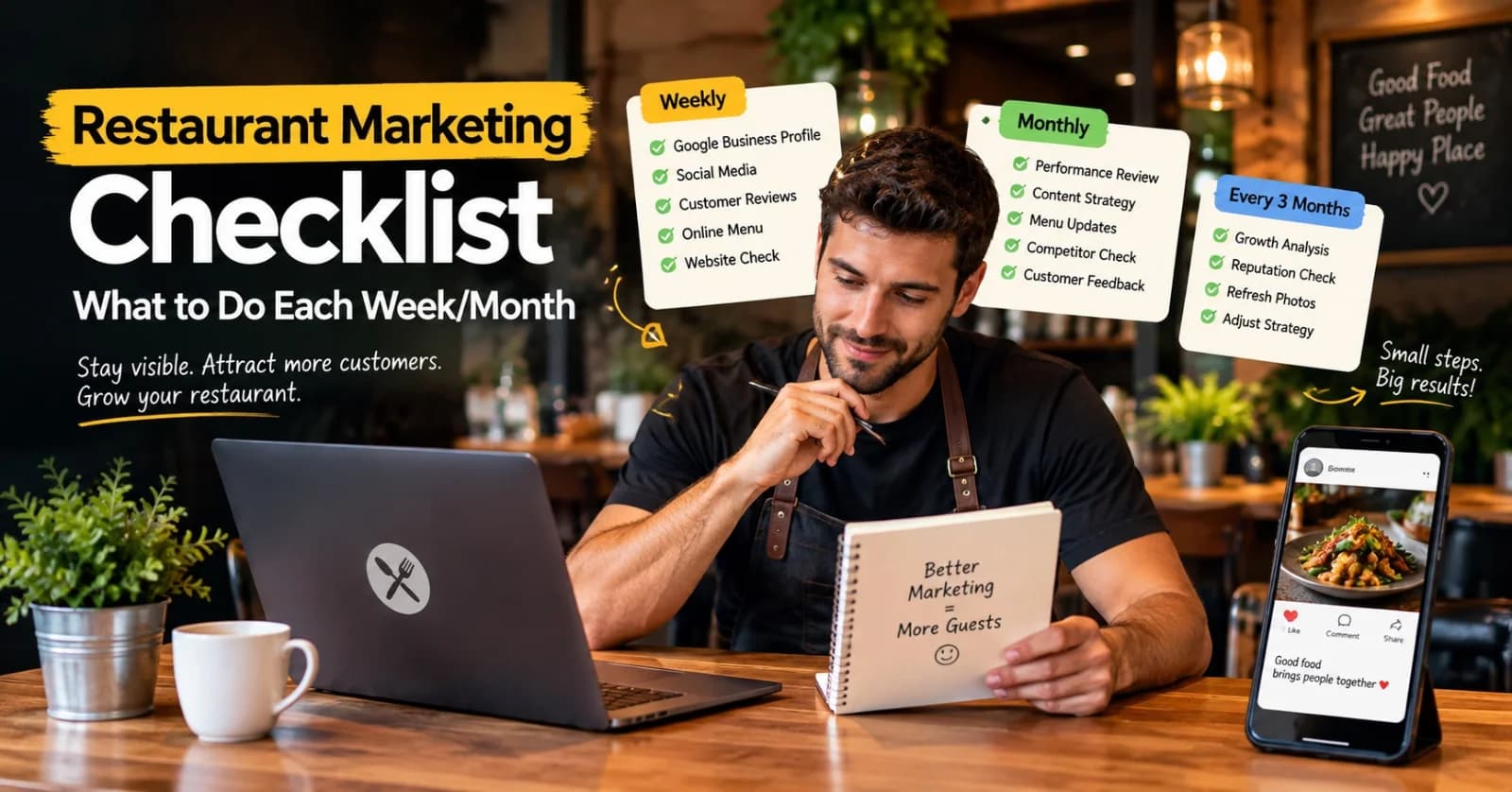
A realistic, no-burnout routine for restaurant marketing — what's worth checking weekly, reviewing monthly, and revisiting every few months, without turning it into a second job.
Restaurant Marketing Checklist: What to Do Every Week and Every Month
Restaurant marketing has a way of feeling like a job you're supposed to be doing constantly. Post on Instagram. Update Google. Ask for reviews. Run a promotion. Take a few photos. Check the website. Reply to a comment. Look at the numbers. And somewhere in there, also run the actual restaurant.
That's usually how the burst-and-disappear pattern starts. Five posts in one week, then three weeks of silence, then a sudden "wait, when did we last update anything online?"
You don't need to be doing restaurant marketing every waking hour. You need a routine simple enough that the basics never quietly slip — something you can return to every week without it eating your whole day. This checklist splits that routine into what's worth doing weekly, monthly, and every few months, and you can shape it around your own time, staff, and budget. The point isn't finishing every task perfectly. It's not letting things go quiet for a month at a time.
What Restaurant Marketing Is Actually For
Before getting into the checklist itself, it's worth being clear about the job marketing is doing. It's not just posting food photos because you're supposed to.
Good restaurant marketing answers the questions a hungry person is actually asking: Does this place look decent? What kind of food do they do? Where are they, and are they open right now? What's on the menu? What do other people think of it? Is there a reason to go this week specifically? And if I want to reach them, how?
If your marketing gets attention but doesn't answer those questions somewhere along the way, you're generating awareness without making it easy for anyone to actually become a customer. That's why this list covers more than social media — the website and the menu behind it matter just as much as what gets posted.
The Weekly Checklist
These are worth a quick pass every week. They don't need to happen all on one day — spreading them out is often easier to sustain.
Check Your Google Business Profile
Start here, since it's often the first thing someone sees when they're already deciding where to eat. Run through opening hours, any special hours coming up, your address, phone number, website and menu links, category, recent photos, and any unanswered customer questions or new reviews.
This takes a few minutes when everything's already correct. It takes a lot longer to undo the damage after someone's shown up to a listing that said you were open. The quick test: if someone searched for your restaurant right now, is every piece of information they'd see actually true? If not, that gets fixed before the next Instagram post does.
Reply to New Reviews
Make this a weekly habit rather than something you do only when a bad one shows up. Thank people for positive reviews — even a short "thanks for visiting, glad you liked the burgers, hope to see you again soon" goes a long way — and respond thoughtfully when there's a complaint. Reviews aren't only feedback for the person who wrote them; everyone reading your page afterward sees how you handled it. If you're dealing with a genuinely frustrating one, it's worth slowing down and following a proper process rather than replying in the moment.
Publish One or Two Things Worth Seeing
You don't need seven posts a week. For most small restaurants, one or two genuinely good pieces of content land better than a flood of forgettable ones. That could be a popular dish, something new on the menu, a quick kitchen clip, a staff introduction, a seasonal item, or just a shot of the room on a good night. The useful question isn't "what should we post today" — it's "what would actually make someone want to come in this week." That's a much better filter.
Get the Food Photographed Properly
You don't need a proper camera, just usable shots — decent light, clean plating, real portions, the food photographed close to when it left the kitchen rather than sitting for ten minutes. Photograph what you'd actually want someone deciding where to eat tonight to see, not just whatever's easiest to grab a photo of.
Check the Online Menu
This is one of the easiest things to let slip. Open your website and go through the menu like a customer would — removed dishes, new dishes, wrong prices, missing items, anything reading oddly on a phone screen. If something's changed in the kitchen but not on the site, you're creating confusion before anyone's even walked in. This is exactly the kind of thing worth being deliberate about when you're setting a restaurant's online presence up in the first place, and it's covered in more depth in our piece on getting a new restaurant's online presence right from day one — the same upkeep habits apply just as much six months in as they do in week one.
Open Your Website on Your Phone
Don't assume it still looks fine because you checked it a while back. Load it on your phone and go through it as a stranger would: does it load quickly, can you find the menu in a couple of taps, is the address and hours obvious, does the contact button actually work, are the photos loading properly? If you have to hunt for basic information, customers are doing the same hunting and most won't bother finishing it.
Check Messages and Comments
Go through DMs, comments, and mentions. Someone asking "are you open Sunday?" or "do you have vegetarian options?" isn't just a message to answer — it's a clue about information that's currently too hard to find. If the same question keeps coming up, that's a sign to make the answer more visible on your Google profile and website rather than answering it one DM at a time forever.
Glance at What Nearby Competitors Are Doing
Ten or fifteen minutes, not an afternoon. Look for new menu items, current promotions, how they're presenting themselves, what customers are complaining about on their page. The point isn't copying — it's spotting gaps. If every restaurant nearby is posting the same close-up food shots and nobody's showing what the actual room feels like on a Friday night, that's an opening.
The Monthly Checklist
Weekly tasks keep things ticking over. Monthly ones are where you actually step back and ask whether any of it is working.
Look at the Numbers That Matter
This doesn't need a dashboard. Depending on what you already have access to, glance at website visitors, menu views, Google profile interactions, calls, direction requests, social reach and engagement, new reviews, and your average rating. What matters is spotting a pattern, not obsessing over any single number. If website visits are climbing every month but nobody's actually calling or getting directions, traffic clearly isn't the whole problem. If one kind of post consistently gets more engagement, that's worth leaning into.
Figure Out What Actually Performed
Look back over what you posted and be honest about what worked. A post with ten thousand views that nobody acted on can matter less than one with a thousand views that sent people straight to the menu. The distinction worth chasing is between content that gets attention and content that gets action — they're not always the same thing.
Review the Menu as a Marketing Tool, Not Just a List
Go through best sellers, slow movers, high-margin dishes, and anything customers keep asking questions about. If a dish is consistently popular, it deserves more visibility — a featured post, a spot on the homepage, a staff recommendation — rather than sitting quietly on page two of the menu. Often the strongest marketing material you have is already sitting in the kitchen; it just isn't being shown enough. If the menu itself feels like it's working against you here — too long, nothing standing out, customers constantly asking what a dish actually is — that's usually a structure problem more than a marketing one, and our guide to restaurant menu design and psychology goes into that specifically.
Search for Your Own Restaurant
Type in your restaurant's name, "[name] menu," "[name] reviews," "[name] opening hours," and just look at what actually comes up. You're not trying to game anything — you're checking what a stranger sees in the two seconds before they decide whether to click through. Fix whatever looks outdated or wrong.
Ask Customers a Couple of Real Questions
No formal survey needed. "How did you hear about us," "what made you choose us tonight," "is there anything you wish we had" — asked in passing by a server — can surface things you'd never guess. Sometimes you'll find out people are discovering you through a channel you weren't paying attention to, or that the dish you thought was your signature isn't the one anyone actually talks about.
Check Whether Promotions Are Actually Working
If you run discounts, look at them properly once a month rather than assuming busy equals successful. Did the offer bring in new customers, or mostly get used by people who would've come anyway? If a $20 meal goes out at $12 to people who'd have paid full price regardless, that's margin given away, not marketing working. A promotion should support the business, not just make the socials look active for a week.
Give the Website a Proper Monthly Check
Beyond the weekly glance, take a slower pass: does the phone number actually connect, is the address right, do the hours match reality, are the photos still representative of what the restaurant looks like now, does everything load properly on mobile, do the buttons and menu links all work. None of this needs to be elaborate — a small restaurant mostly just needs a website that reliably does its one job: telling people what they need to know before they decide to come in.
Every Few Months: The Bigger-Picture Review
Not every decision needs revisiting weekly. Every couple of months, it's worth pulling back further.
Find Out Where Customers Are Actually Coming From
Google, Maps, Instagram, word of mouth, a delivery platform, a neighboring business sending people your way — try to get a real sense of this rather than guessing. If seventy percent of new customers are finding you through Google and almost nobody's coming from anywhere else, your time is probably better spent there than spreading thin across five platforms nobody's using to find you.
Look for Patterns in Your Reputation, Not Just Individual Reviews
Step back from the last one or two reviews and look at the last few months as a set. Do people keep mentioning the same things — friendly staff, generous portions, slow service on weekends, a particular dish, difficult parking? Repeated praise is a message you should probably be using in your marketing. Repeated complaints are usually pointing at an operational fix, not a PR problem.
Refresh the Photos
Restaurant photos age even when they're technically fine, simply because the restaurant itself moves on — new dishes, new plating, a renovated corner, new staff. Every few months, take a fresh pass so what people see online still matches what they'll actually walk into.
Look at Competitors Again, With Fresh Eyes
Not to copy them — to understand the market you're actually competing in. What are they doing better? What are you doing better? Maybe their photography's sharper but your food's better. Maybe they compete on price and you compete on consistency. Knowing that clearly makes every other marketing decision easier, because you know what you actually want people to remember about you.
If This Feels Like Too Much: A 30-Minute Weekly Routine
If the full list feels like a lot, here's a stripped-down version that still covers what matters most.
10 minutes — Google and reviews: check the profile, confirm hours, check new reviews, reply where needed.
10 minutes — website and menu: open the site, check the menu's accurate, test the contact button.
10 minutes — content: one good photo or short clip, posted, plus a quick pass through comments and messages.
Done consistently, that beats an occasional three-hour marketing binge every couple of months by a wide margin.
A Simple Monthly Rhythm
If you want to give yourself a bit more structure across the month:
Week 1 — visibility: Google profile check, fresh photos, review check, a search for your own restaurant.
Week 2 — content: look at what performed best recently, plan the next few posts, photograph anything new.
Week 3 — website and menu: accuracy check on the menu, hours, and contact details; test everything on mobile.
Week 4 — analysis: traffic and customer sources, promotion performance, feedback, and a decision on what to keep, drop, or adjust.
Nothing complicated — just something repeatable enough that it actually happens.
What Doesn't Belong on This List
A good checklist should also say what to stop doing.
Posting for the sake of hitting a number doesn't make a restaurant more appealing — four relevant posts beat seven forgettable ones. Chasing every new platform your customers aren't actually on wastes time better spent on the two or three that matter. Abandoning a strategy after one underperforming post doesn't give it a fair shot — patterns take a bit longer to show up. Constant discounting teaches people to wait for the next one instead of paying full price, which quietly erodes the menu you worked hard on. And measuring success purely in likes misses the point — a like doesn't fill a table. The better questions are whether people are finding you, visiting the site, checking the menu, calling, getting directions, and coming back.
The Short Version, if You Just Want a List
Every week: check the Google profile and hours, reply to new reviews, check messages, post something worth seeing, grab fresh food photos, check the online menu, open the website on your phone, glance at a couple of competitors.
Every month: review traffic and Google interactions, note what content performed best, review menu performance, search for your own restaurant, ask customers a question or two, check promotion results, confirm website links and info, refresh photos if needed.
Every few months: figure out where new customers are actually coming from, look for repeated themes in reviews, refresh restaurant photos properly, take another look at competitors, and decide what's worth continuing versus dropping.
Marketing Works Better as a Habit Than a Campaign
None of this requires becoming a marketing expert, posting daily, or being active on every platform that exists. It requires keeping the fundamentals healthy — accurate information, a website that actually works, a menu that matches reality, reviews that get real responses, a bit of fresh content, some honest customer feedback, and a regular look at what's actually happening. Then doing it again next week.
Most restaurant owners who struggle with this aren't doing anything particularly wrong — they're just trying to hold all of it in their head at once instead of turning it into a routine. Spend a little time each week keeping things accurate and visible, a little more each month checking what's working, and marketing stops feeling like a campaign you have to keep reinventing. It just becomes part of running the place.
Ready to build your restaurant's online presence?
Menuberg helps restaurants launch a professional website and QR digital menu in minutes — no coding required.
Create Your Restaurant WebsiteRelated Articles
New Restaurant Checklist: Getting Your Online Presence Right From Day One
A practical, ordered checklist for getting your restaurant's website, Google profile, menu, and social presence right before, during, and after opening week — not scrambled together at the last minute.
3 Sept 2026 · 12 min read
How to Handle Negative Restaurant Reviews: A Practical Dos and Don'ts Guide
A bad review doesn't have to hurt your restaurant's reputation — how you respond to it does more work than the review itself. Here's a clear, practical dos-and-don'ts approach.
6 Sept 2026 · 14 min read
How to Get Repeat Customers Without a Loyalty App
Loyalty apps aren't what actually brings restaurant customers back. Here's what does — and how small, independent restaurants can build real repeat business without an app or a points system.
31 Aug 2026 · 9 min read
About Menuberg
Menuberg helps restaurants create professional websites and digital storefronts without complicated setup. Learn more.