
Home → Blog → Restaurant Growth → How to Price Your Restaurant Menu Without Scaring Customers
How to Price Your Restaurant Menu Without Scaring Customers
Pricing your restaurant menu isn't just about covering ingredient costs. Learn how to set profitable prices while making customers feel they're getting fair value.
How to Price Your Restaurant Menu Without Scaring Away Customers
You've probably run into this problem before.
You work out the cost of a dish, only to realize that almost everything has become more expensive. Ingredients cost more. Rent has gone up. Labor isn't getting any cheaper. Even your suppliers seem to change their prices every few weeks.
So you raise the price.
Then you look at your menu and wonder:
"Is anyone actually going to pay this?"
That's where restaurant pricing gets tricky.
Price your food too low, and you can end up with a packed restaurant that barely makes any money. Price it too high, and customers may look at the menu, hesitate, and order something else.
The goal isn't to make everything as cheap as possible.
It's to find a price that's profitable for you and reasonable from the customer's point of view.
Those two things don't always line up perfectly.
Here's how to price your restaurant menu without making customers feel like everything is overpriced.
Start With Your Actual Food Cost
Before worrying about pricing psychology, competitors, or whether $14.99 "looks better" than $15, figure out what each dish actually costs you.
Start with the ingredients that go into one serving.
Let's say you sell a chicken burger. Your approximate cost might look something like this:
- Chicken: $2.00
- Bun: $0.60
- Cheese: $0.40
- Sauce: $0.20
- Vegetables: $0.30
- Seasoning and oil: $0.20
- Packaging: $0.30
That's $4.00 in direct costs.
But that $4 isn't the full cost of running your restaurant.
You still have to pay for things like:
- Staff
- Rent
- Electricity
- Gas
- Equipment
- Cleaning
- Marketing
- Taxes
- Waste
- Delivery or platform fees
- Other operating expenses
So don't look at food cost and think, "It costs me $4, so I'll just charge $8."
Food cost is a starting point. It isn't the entire pricing decision.
Use Food Cost Percentage as a Starting Point
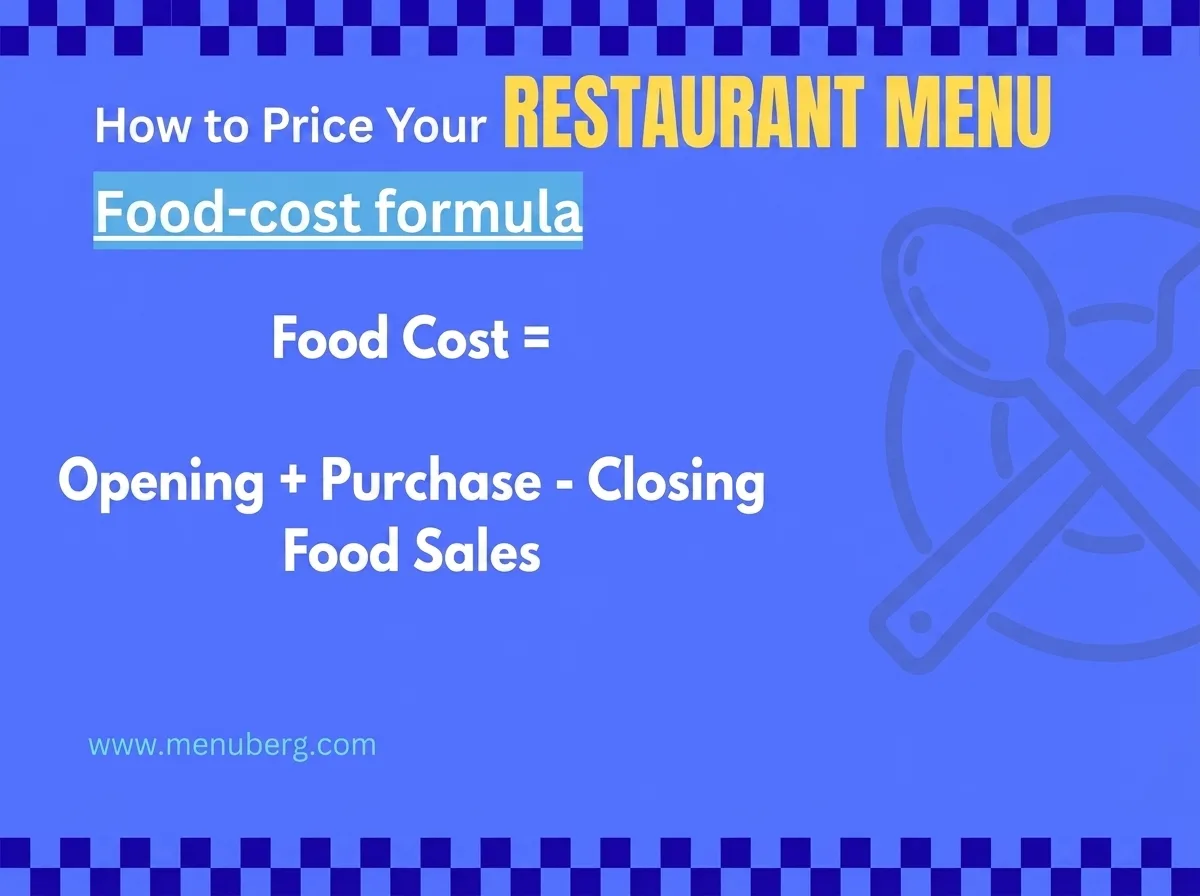
A common way to establish a starting price is to work backward from your target food-cost percentage.
The basic formula is:
Menu Price = Food Cost ÷ Target Food Cost Percentage
For example, if a dish costs you $4 to make and you're aiming for a 30% food cost:
$4 ÷ 0.30 = $13.33
That gives you a starting point of around $13.33.
You might then adjust that to a cleaner price that makes sense for your menu and your market.
But here's the important part: $13.33 isn't automatically the correct selling price.
It's simply a financial starting point.
If similar restaurants in your area sell comparable dishes for $10, charging $13.33 might be difficult.
On the other hand, if customers regularly pay $16 for similar dishes and yours offers something that makes it worth choosing, charging $10 could mean you're leaving money on the table.
The math tells you what your business needs.
Your market tells you what customers may accept.
You need both.
Don't Just Copy the Restaurant Next Door
Looking at competitors is useful.
Copying their prices isn't.
Imagine the restaurant next door sells a burger for $12. You sell a similar burger, so you decide yours should also cost $12.
But you don't know their:
- Ingredient costs
- Rent
- Employee wages
- Portion sizes
- Waste levels
- Sales volume
- Delivery costs
- Profit margins
They might be making excellent money at $12.
Or they might be barely breaking even.
You have no way of knowing just by looking at their menu.
Use competitor prices as market information, not as your pricing formula.
A better question is:
"What are customers already willing to pay for something similar?"
Then compare that with your own costs, your positioning, and the value you're offering.
The Price Has to Make Sense Before It Can Feel Right
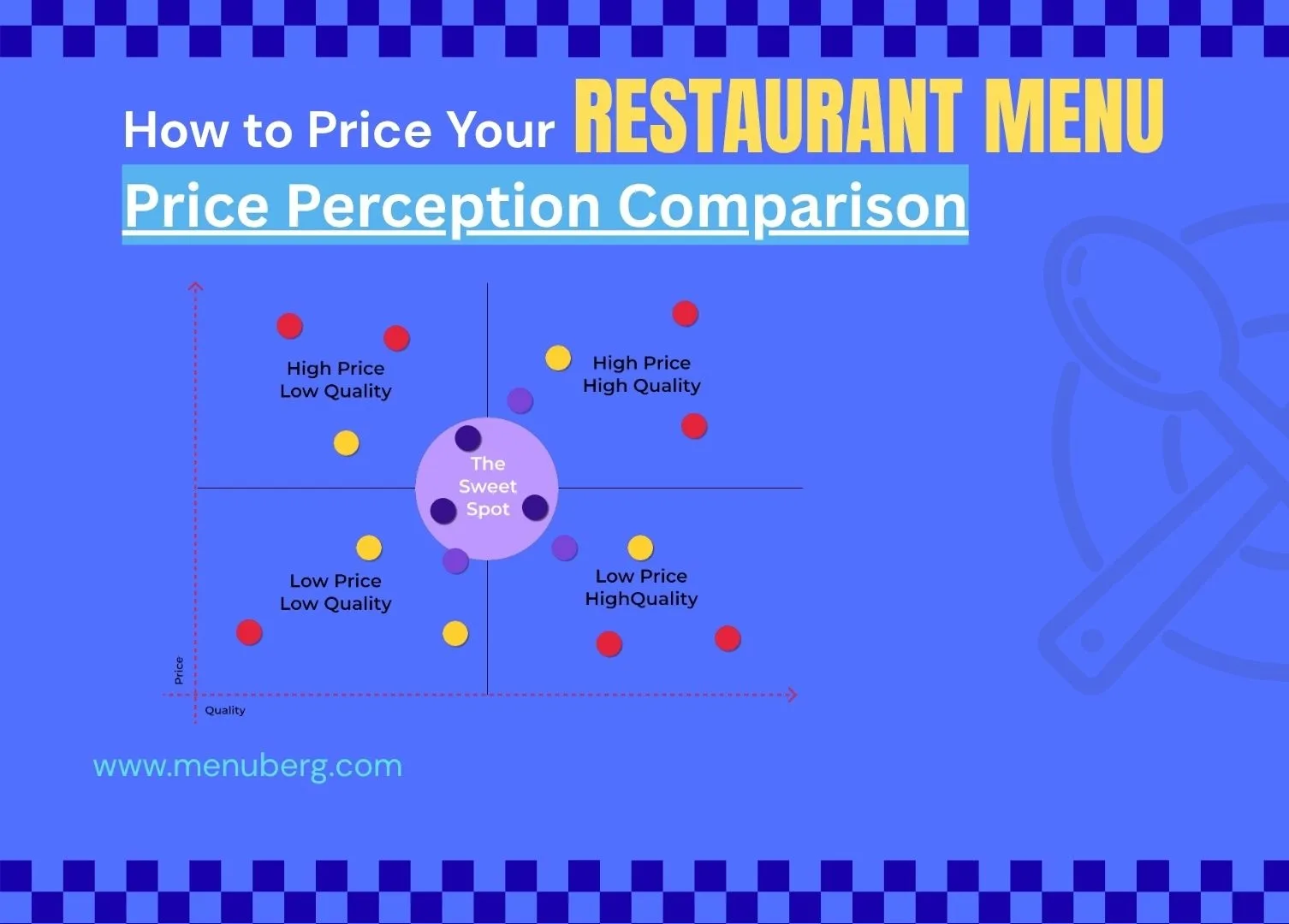
Customers don't see your supplier invoices.
They don't know how much your rent increased or how much you spent on your kitchen equipment.
They see the dish and the price.
That's why a $20 dish can feel completely reasonable at one restaurant and ridiculously expensive at another.
Customers judge the price alongside things like:
- Ingredients
- Portion size
- Presentation
- Restaurant atmosphere
- Reputation
- Location
- Service
- Description
- Photography
- Other prices on the menu
In other words, pricing isn't purely mathematical.
Customers don't buy numbers. They buy perceived value.
Don't Hide an Expensive Dish Behind a Weak Description
Compare these two menu items:
Grilled Chicken — $19
Now look at:
Charcoal-Grilled Chicken Breast, Lemon Herb Sauce, Roasted Potatoes — $19
The price hasn't changed.
The food might not have changed either.
But the second description tells the customer much more about what they're getting.
It gives them information about the:
- Cooking method
- Flavor
- Ingredients
- Sides
That makes the $19 price easier to understand.
Of course, this doesn't mean you should turn every menu item into a paragraph filled with words like "luxurious," "exquisite," and "premium."
Keep descriptions accurate.
If the dish isn't special, don't pretend it is.
The point isn't to convince customers that ordinary food is something extraordinary.
It's to communicate the value that's actually there.
Don't Make Every Price Look Cheap
When restaurant owners worry about losing customers, it's tempting to make every price look as inexpensive as possible.
That often leads to menus filled with prices like:
- $9.99
- $11.99
- $13.99
- $15.99
- $17.99
There's nothing inherently wrong with that pricing style.
But it isn't right for every restaurant.
A casual restaurant competing heavily on value may have no problem using prices ending in .99.
A higher-end restaurant focused on quality and craftsmanship may feel more natural using round numbers.
Compare:
Steak — $39.99
with:
Grilled Ribeye — $40
Neither is automatically better.
But they communicate slightly different things.
The first feels more like a retail price. The second can feel simpler and more deliberate.
There's no universal rule that says every restaurant needs to use one format.
Choose a pricing style that fits your brand and stick with it.
Be Careful With $9.99, $19.99 and $29.99
Charm pricing—using $9.99 instead of $10—is common in retail.
That doesn't mean you need to use it everywhere on your restaurant menu.
Think about what you want your prices to communicate.
If your restaurant is built around affordability and value, $9.99 might fit perfectly.
If you're selling premium ingredients, craftsmanship, or a more upscale experience, a clean $10 may feel more appropriate.
The important thing is consistency.
Don't use $9.99 simply because another restaurant does.
Your pricing style should match your positioning.
Don't Make "Cheap" Your Entire Strategy
If you're worried about price-sensitive customers, your first instinct might be to add as many cheap dishes as possible.
You don't necessarily need to do that.
Instead, give customers a range of choices.
For example:
Classic Burger — $10
Smoky BBQ Burger — $14
Double Steakhouse Burger — $19
Now customers can choose based on their budget and what they're looking for.
Someone who wants an inexpensive meal has an option.
Someone looking for something more filling has another.
And someone willing to spend more can choose the premium option.
That's usually a better strategy than trying to make the entire menu compete on the lowest possible price.
Give Customers a Reference Point
People rarely judge a price completely on its own.
They compare it with something else.
Imagine your menu has:
Chicken Pasta — $18
Seafood Pasta — $24
The $18 pasta might initially feel expensive to someone expecting a $12 meal.
But next to the $24 dish, it can suddenly look like the more affordable option.
That's why menu structure matters.
You're not only deciding what each dish costs.
You're also deciding how those prices look next to one another.
That doesn't mean you should add a ridiculous $50 dish just to make your $25 dish look cheap.
Customers can tell when something feels artificial.
The reference point has to be believable.
Make Your Prices Easy to Understand
A customer shouldn't have to work out your menu.
Avoid confusing pricing formats, tiny text, inconsistent decimals, or prices that are difficult to associate with the right dish.
A customer should be able to answer three simple questions quickly:
What is it?
What comes with it?
How much is it?
That's really all they need.
Good menu design reduces the amount of mental effort customers have to spend making a decision.
And when the menu is easy to understand, customers can focus on choosing what they actually want to eat.
Don't Turn Your Menu Into a Price Spreadsheet
Imagine a menu designed like this:
Chicken Pasta ........ $14 Beef Pasta ........... $16 Seafood Pasta ........ $22 Steak ................ $28
Everything is neat and organized.
But there's a problem.
The customer's eyes can quickly start jumping from one price to another.
Instead of thinking about the food, they're comparing numbers.
A better approach is to keep each price visually connected to its dish and description.
Let customers understand the food first.
Then let the price become part of the decision.
This doesn't mean hiding prices.
Customers should always be able to see what they're paying.
It's simply about presenting the price as part of the product instead of making your menu feel like a spreadsheet.
Price is only one part of how customers experience your menu. Menu design and psychology can influence how easily customers understand their choices.
Make Expensive Items Earn Their Price
If you're going to charge more, customers should have a reason to understand why.
That could be:
- Premium ingredients
- A larger portion
- Special preparation
- Imported ingredients
- A unique recipe
- Better presentation
- More substantial sides
- A specialty cooking method
- A signature dish
Compare:
Pasta — $25
with:
Slow-Braised Beef Short Rib Pasta, Parmesan Cream Sauce — $25
The second description gives the customer much more information about what they're paying for.
Again, be honest.
If the dish genuinely costs more because of its ingredients or preparation, communicate that.
Don't simply increase the price and hope nobody notices.
Watch Your Portion Sizes
Sometimes a restaurant doesn't actually have a pricing problem.
It has a value perception problem.
Imagine two restaurants both charge $18 for a chicken dish.
Restaurant A serves a small portion on a large, mostly empty plate.
Restaurant B serves a generous portion with attractive sides.
The price is identical, but customers may walk away feeling that Restaurant B offered better value.
Before lowering your price, ask yourself:
"Could I improve the customer's perception of value instead?"
Maybe the answer is:
- Better presentation
- A clearer description
- A slightly different portion size
- A side that actually adds value
- Better food photography
- Clearer information about what's included
Dropping the price shouldn't always be your first solution.
Don't Raise Prices Randomly
Ingredient costs change all the time.
That doesn't mean you should increase every menu item by the same amount every time your supplier raises a price.
Look at each dish individually.
Ask:
- Has its ingredient cost changed?
- How popular is it?
- What margin does it generate?
- What are similar restaurants charging?
- Has the portion changed?
- Is the dish still positioned correctly?
- Have customers' buying habits changed?
A $1 increase on a dish that sells hundreds of times a month can have a very different impact from a $1 increase on a dish that barely sells.
Pricing should be something you review as part of managing your menu—not a number you set once and forget forever.
If You Need to Raise Prices, Don't Apologize for It
Raising prices can feel uncomfortable.
You might be tempted to write something like:
"We're sorry, but our prices have increased because everything is so expensive."
If you genuinely need to raise your prices, you don't need to sound guilty about it.
Your restaurant needs to make enough money to pay its employees, cover its expenses, maintain quality, and stay open.
That's normal.
If customers need an explanation, be transparent.
But don't make your menu sound like an apology letter.
A restaurant that constantly underprices its food eventually faces a much bigger problem:
It may not survive.
Don't Use Discounts to Fix Bad Pricing
Suppose your burger actually needs to sell for $15.
Instead, you price it at $18 because you want a bigger margin.
Customers don't buy it.
So you run a permanent 20% discount.
Now you're effectively selling it for $14.40.
You haven't really solved the pricing problem.
You've just created a more complicated pricing system.
Discounts can absolutely be useful for specific campaigns, slow periods, or attracting new customers.
But your regular menu price should make sense on its own.
If customers only think your food is affordable when there's a discount attached, that's something worth paying attention to.
Give Your Menu Different Price Levels
A healthy menu doesn't need every dish to cost roughly the same.
Give customers options.
Think of your menu in three broad levels:
Budget-Friendly
These are dishes that let price-sensitive customers order without feeling priced out.
Core Range
These are the dishes you expect a large portion of your customers to choose.
Premium
These are higher-priced dishes that offer something more substantial, specialized, or distinctive.
For example, one customer might spend $12.
Another might spend $20.
Someone else might happily spend $35.
You don't need to force all three customers into the same spending range.
Give each of them a reasonable choice.
Test Your Prices Instead of Guessing
You don't need to completely redesign your menu every time you want to learn something about pricing.
Start tracking what actually happens.
Pay attention to things like:
- Number of orders per item
- Percentage of customers choosing each item
- Revenue per item
- Food cost
- Contribution margin
- Average customer spend
Let's say you raise a popular dish from $14 to $16.
If sales drop on one Tuesday, that doesn't automatically mean customers hate the new price.
Look at the trend over a reasonable period.
Weekends, weather, holidays, promotions, seasonality, and other factors can all affect sales.
The more consistently you track your menu, the less you have to rely on guesswork.
The Cheapest Price Isn't Always the Best Price
This is probably the most important idea in restaurant pricing.
Your goal isn't:
"How can I make this dish as cheap as possible?"
It's:
"What price allows me to run a sustainable restaurant while giving customers a reasonable sense of value?"
Those are two very different questions.
A $10 dish that barely makes you any money isn't necessarily better than a $14 dish that customers happily order and that actually contributes to your business.
At the same time, a $25 dish isn't automatically overpriced.
If customers understand what they're getting and the overall experience supports the price, $25 may be perfectly reasonable.
Price isn't just a number.
It's also part of how customers understand your restaurant.
A Simple Menu Pricing Checklist
Before publishing your prices, ask yourself:
- Do I know the actual ingredient cost of each dish?
- Have I considered packaging and other direct costs where relevant?
- Have I established a sensible food-cost target?
- Does the resulting price make sense for my local market?
- Have I checked what similar restaurants are charging?
- Am I offering different price levels?
- Does each premium item have a clear reason for its higher price?
- Do my descriptions communicate the value that's actually there?
- Are my prices easy to read?
- Is my pricing format consistent?
- Am I relying too heavily on discounts?
- Am I tracking which dishes actually sell?
- Do my prices leave enough room for the restaurant to operate sustainably?
Final Thought: Don't Try to Make Everyone Happy With Your Prices
You'll never create a menu where everyone thinks every item is cheap.
And you shouldn't try.
Some customers want the cheapest meal possible.
Some care about portion size.
Some care about ingredients.
Some want premium food.
Some care about atmosphere.
Some just want their favorite dish and don't think about the price much at all.
Your job isn't to make your entire menu look cheap.
Your job is to make the value easy to understand.
Know what your food costs.
Understand what your market is willing to pay.
Give customers meaningful choices.
Present your prices clearly.
Explain the value honestly.
And keep an eye on what people actually order.
A well-priced menu doesn't make customers think:
"This is cheap."
It makes them think:
"That sounds worth it."
And that's a much better goal.
Ready to build your restaurant's online presence?
Menuberg helps restaurants launch a professional website and QR digital menu in minutes — no coding required.
Create Your Restaurant WebsiteRelated Articles
How to Handle Negative Restaurant Reviews: A Practical Dos and Don'ts Guide
A bad review doesn't have to hurt your restaurant's reputation — how you respond to it does more work than the review itself. Here's a clear, practical dos-and-don'ts approach.
6 Sept 2026 · 14 min read
Restaurant Marketing Checklist: What to Do Every Week and Every Month
A realistic, no-burnout routine for restaurant marketing — what's worth checking weekly, reviewing monthly, and revisiting every few months, without turning it into a second job.
11 Sept 2026 · 13 min read
New Restaurant Checklist: Getting Your Online Presence Right From Day One
A practical, ordered checklist for getting your restaurant's website, Google profile, menu, and social presence right before, during, and after opening week — not scrambled together at the last minute.
3 Sept 2026 · 12 min read
About Menuberg
Menuberg helps restaurants create professional websites and digital storefronts without complicated setup. Learn more.